
Macon County Multi-Day Arrest Sources
Macon County has no sheriff webpage that works as a full multi-day blotter. The county public-notices page still links to an old sheriff press-release path. That path returns an error. So the practical record landscape splits four ways. The Sheriff's Office holds the official booking record. Weekly papers publish what their schedules allow. An irregular local crime report fills gaps. Private booking mirrors post whatever they collect. Each piece behaves differently. A weekly story covers an editorial period set by a print schedule. A private archive follows its own collection and retention rules. A sheriff response is official, but you may need a focused request to get it. Call none of them a complete arrest database. When accuracy matters, start with the official record holder. Then use published reports. They can pin down a likely date or agency for a Macon County arrest.
Macon Arrests in Weekly Reports
Macon County's weekly press makes this multi-day pattern easy to see. One Franklin Press issue carried both a "Crime Report" and an "Arrest Record." The pair covered January 23 through January 29. It listed Franklin Police Department and Macon County Sheriff arrests. Each entry gave date, name, charge, and arresting officer. That layout invites date-by-date digging. Just remember it is a news report, not the official booking record. The Macon County News & Shopping Guide has run compiled arrest reports too. Issues have covered windows like August 2 through August 7 and October 14 through October 23. One older issue carried a longer span. Some entries mix in neighboring agencies alongside Macon Sheriff and Franklin Police items. Check the named agency and county on every line. Do not assume each one reflects a Macon County Detention Center booking. The Macon County News current landing page shows the latest issues the paper has posted.

The landing page points you to issue-based coverage. Each issue still demands its own date-range and agency check.
Reading Macon County Arrest Reports
Read Macon County arrest reports backward from the event itself. The newest web result is the wrong starting point. Pin down the source's true window first. Then trace the arrest toward its official record. Keep two traps in mind. A newspaper's issue date is not the arrest date. And a private archive's page date may just mark an update, not the actual booking time.
- Open the issue, article, or archive page and write down its stated reporting range. If it gives only dates beside entries, do not invent a weekly window.
- Identify the arresting agency on each relevant line. Franklin Police, Highlands Police, the Macon County Sheriff, and an outside agency may hold different source records.
- Read the charge as attributed text. Do not shorten it into a claim that the named person committed the offense.
- Check the Macon County court gateway for later case events, and contact the clerk for an official copy when the outcome matters.
- For an older or missing entry, request the record from the agency that created or retained it, using the approximate date and any case or booking number.
A shared name proves nothing. Check age, agency, date, and case identifiers to separate records. For present custody rather than a past window, follow the Macon County Arrests Last 24 Hours official-check sequence.
Macon Police Blotter Entry Fields
Entry fields vary by source class in Macon County. Weekly papers use a lean text format. Private archives go further, adding physical descriptions, booking time, bond amounts, and a booking photo. North Carolina law defines which arrest facts are public. It does not open every field in an investigation file. Nor does it promise that all the details sit in one Macon County document.
| Field | How to interpret it |
|---|---|
| Report or arrest date | The event date may differ from issue, upload, or page-update dates. |
| Name | Identifies the person named by the source; verify identity through the official record. |
| Agency or officer | Points toward the likely record custodian and distinguishes city from county activity. |
| Charge | States an charge as reported at that stage, not a court finding. |
| Booking time or ID | More common in booking mirrors than weekly press; useful for a focused official request. |
| Bond | May reflect one point in the case and can change by later order. |
| Photograph | Not seen in the reviewed weekly reports; private archives may display one but are unofficial. |
A booking record can also hold custody and release facts a news summary never prints. Ask for those fields directly if they matter to your inquiry. Public reports compress charge text, drop booking numbers, or stop short of any court outcome.
Note: Date, name, charge, and arresting officer were the stable fields observed in Macon’s reviewed issue-based reports.
Macon Private Arrest Archive Windows
Private Macon County sources work on very different clocks. Busted Newspaper runs a paginated county section. Individual records show booking dates, charges, bond details, demographics, and images. Deeper pages reach entries from February 2026. The publisher posts no dependable Macon-specific schedule, though, and controls the archive and any corrections. It is not the sheriff's record. RecentlyBooked works differently. It offers a last-30-days Macon view. You can search by name, date, or charge. It also claims several refreshes per day. Even so, that short window is not a true county weekly blotter. An update stamp cannot prove each Macon booking was added at the same moment. Weigh the booking date against the page retrieval time. Weigh the source type too before concluding anything. The unofficial Busted Newspaper Macon archive displays its paginated county listings.
A private page can hand you a solid lead. Confirm every entry with Macon County, the arresting agency, or the court.
Macon Arrest Reporting After Weekends
Weekends do not create any fixed surge in Macon County arrests. Visibility shifts instead. A Friday arrest may surface in a later app update, next week's paper, an irregular article, or a private archive on its own clock. Holidays can stretch that gap even wider. The pattern is about publishing, not about how many people were arrested.
Deadlines add another layer. The Franklin Press example grouped a full week. Macon County News examples used several-day stretches that were not all the same length. Check only one issue and you may miss an event tucked into the next edition or left out by editorial choice. Search issues on both sides of your date. Then ask the responsible agency for the source record.
Macon Sense offers an irregular sheriff crime-report article rather than a predictable blotter. It can add incident detail. Irregular publication, though, is no complete archive. The sheriff's office lists no dependable social or press-release feed. Keep those limits in mind when you weigh any blotter finding.
Macon Arrest Archives Past Publication
A deep archive is not retention. Private sites pick their own pagination. Newspapers keep issues their own way. Government records, meanwhile, follow retention schedules and agency practice, and no exact Macon County booking-photo retention period is published. No fixed number of years should be promised.
North Carolina State Archives schedules give a feel for sheriff operational records. Some annual or biennial activity reports may be permanent. Monthly, bimonthly, or semiannual reports may be destroyed after three years. Daily workload records can go after one year. Those are examples only. They promise nothing about a specific Macon booking sheet or photograph. The deeper private Macon archive page shows how publisher pagination can extend well past the first view of booking photos.
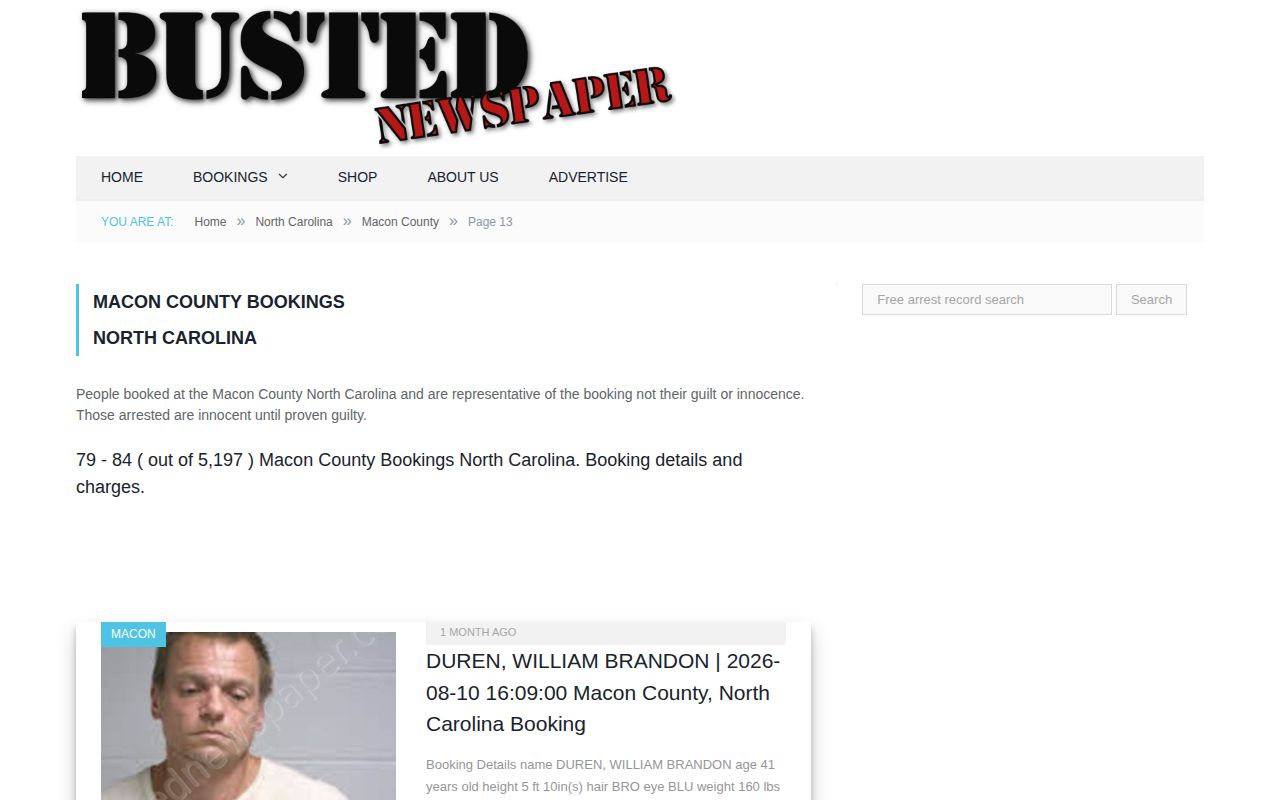
That page shows only what the publisher kept. It says nothing about the county's own retention period.
Note: Ask the custodian which schedule series applies and whether the requested item was transferred, lawfully destroyed, or remains available in redacted form.
Requesting Older Macon Arrest Records
Ask the agency that holds the record. Macon County's public-record materials explain that independent officials such as the Sheriff receive requests directly. A generic county inbox may not be the custodian. For a sheriff or detention record, contact the Macon County Sheriff's Office. The address is 1820 Lakeside Drive, Franklin, NC 28734. The phone line is (828) 349-2104. Email works too at mcsopio@maconnc.org. Describe the record. Be specific. Give the person's full name. Add an approximate date range, the arresting agency, and any booking or case number. Say which item you want. It may be the arrest record, the jail booking sheet, a booking photograph, the release time, or another item. Ask which retention series applies if staff say an old file no longer exists. Confirm current costs and any special-service charge before ordering. For material that has left agency hands, the State Archives County Records Guide can help. County box lists can point to transferred court or administrative records. Archives are not a jail roster. Think of them as a later-stage path for historical material. The Macon County court clerk remains the route for official court copies and disposition.
Macon Blotter Charges Are Allegations
A blotter captures one moment. A booking charge often changes. Later court action may bring dismissal, a plea, a conviction, or another result. A weekly report lags behind. Attribute each claim to its source.
The official Macon County court page supplies the route to those later proceedings. So do eCourts case information and the clerk. An event missing from a later issue did not vanish. A listing in a private archive says nothing about current status. Follow the case through the court.